Ghosts of Trauma
‘Trauma is perhaps the most avoided, ignored, belittled, denied,
misunderstood, and untreated cause of human suffering.’
(Peter Levine)
Sometimes I am struck with a particular kind of unease. This unease comes from a realization that no matter how hard we try ensure the safety of ourselves and those we love, the world can present us with events that are random, unpredictable, or outside of our ability to control, and these events may cause us harm. The climate crisis; the suffering of ordinary people in the conflicts in Gaza, Ukraine and elsewhere; the current global political instability and constant shifting of traditional alignments; the power of unfettered social media to manipulate information so that ascertaining the truth becomes a significant trial; all of these contribute to my experiencing moments of existential anxiety.
In such moments, I experience the world as a very dangerous place. Thankfully, such moments, although very uncomfortable, are relatively brief. I can recognize my
unease for what it is, accept its validity, accept the limitations to what I can do about it. I can integrate the experience, manage it, return to equilibrium.
Yet I know there are many people who experience their everyday world as a constant, continuously dangerous place, and one from which there is no viable escape.
Before I recently retired, I spent almost 40 years working as a clinical psychologist, much of that time with children, young people and adults who were experiencing the consequences of early childhood trauma. I have been witness to lives where, every day, the world presents unpredictable threats and perceived dangers. Where vigilance is a constant state and trust is an unfamiliar visitor.
Those who have experienced trauma have felt the threat of annihilation and the extremes of anguish and terror that accompany that. Memories from such experiences are not stored as coherent sequenced events but as fragmented moments – a colour, a sound, an object, a smell, a shape – that are linked with the
overwhelming emotions of the experience. There is no option to make sense of the experience with logic – no integration which will bring closure and place the event in the past and not the present. The present becomes dangerous as these memory fragments are triggered by multiple elements in the world, accompanied by their attached emotions, but with no understanding of what is happening.
Trauma memories become the ghosts of fear that haunt the present, so the present requires vigilance
to avoid these ghosts.
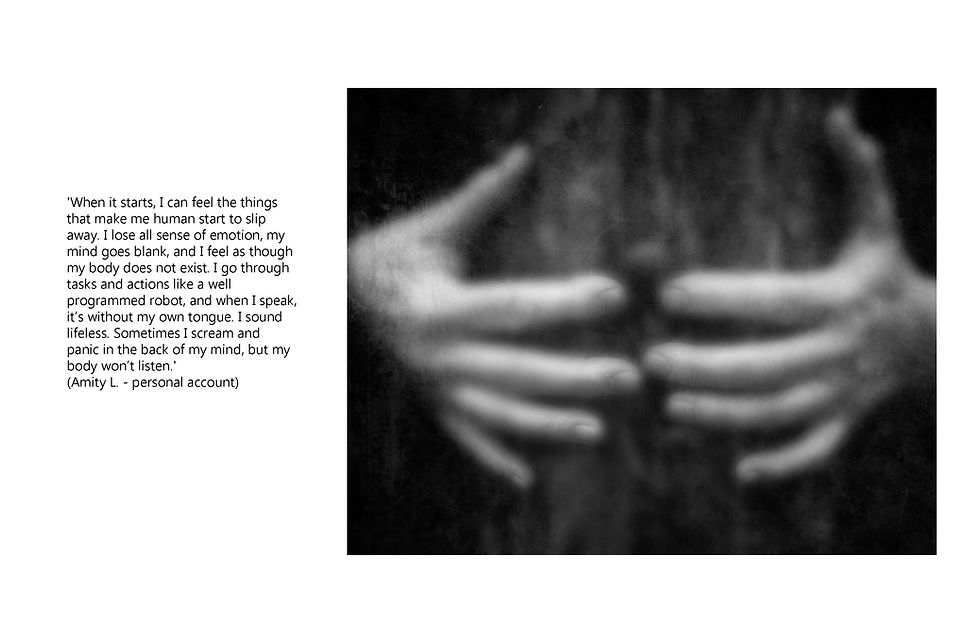
Such vigilance is tiring and consumes a great deal of our mental capacity to engage with the world, to engage with others. Sometimes those with significant unresolved trauma can survive only by becoming dissociated from the everyday world, a condition labelled as ‘depersonalization/derealization disorder’. They become ‘separate’ from their emotions and therefore from their sense of self, from feeling ‘real’.
They avoid the ghosts of trauma that populate their ‘reality’ but only at the cost of becoming ghosts
themselves.